
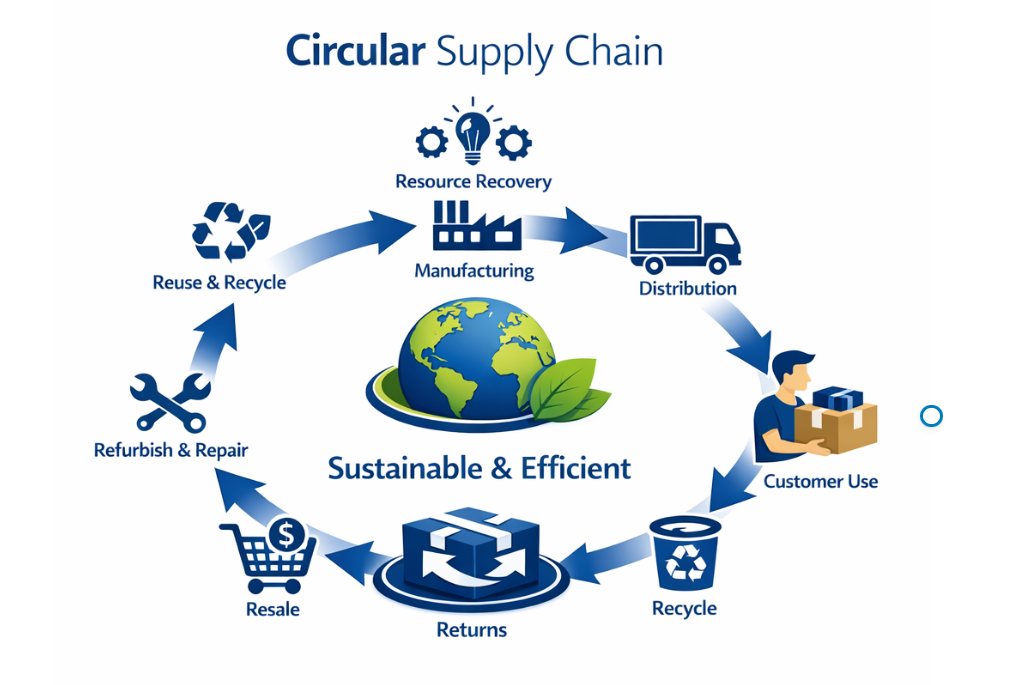
Circular supply chains are reshaping how organizations manage returns, recover value, and support sustainability goals. By extending product lifecycles through reuse, refurbishment, and resale, companies can reduce waste while unlocking new revenue streams.
Yet, while the concept is compelling, execution is far from simple. Circular models introduce real operational and financial tradeoffs—ones that can quietly erode value if not tightly managed. In practice, success comes down to how effectively reverse logistics, recommerce, and fulfillment operations are orchestrated together.
Where Circular Supply Chains Break Down
The most common failure points aren’t strategic—they’re operational.
Reverse logistics is often the first constraint.
Traditional supply chains are engineered for outbound efficiency, not inbound complexity. Circular models introduce unpredictable return volumes, item-level inspection requirements, and fragmented decisioning around disposition. Without structure and scale, returns operations quickly shift from a value opportunity to a cost burden.
The gap between recovery value and processing cost widens.
In theory, value recovery depends on speed, accurate grading, and optimized resale channels. In reality, every additional touchpoint adds cost. Delays reduce resale windows, and poor routing decisions diminish market value. The result is a persistent gap between what products should return and what they actually deliver.
Recommerce is underdeveloped as a capability.
Many organizations treat recommerce as an afterthought rather than a strategic function. This often leads to unnecessary liquidation, underutilized secondary channels, and pricing that fails to reflect real-time demand. Over time, that translates into meaningful revenue leakage.
Fulfillment networks remain misaligned.
Most fulfillment environments are designed for speed, volume, and standardization. Circular supply chains demand something very different: multi-directional flows, flexible handling, and tight integration across forward and reverse operations. When these capabilities don’t align, silos form—and scalability suffers.
Turning Tradeoffs into Advantage
Leading organizations don’t eliminate these challenges—they operationalize them.
They treat reverse logistics as a value engine rather than a cost center by centralizing returns processing, standardizing grading workflows, and enabling real-time routing decisions. This creates consistency, improves throughput, and supports more predictable cost structures.
At the same time, they elevate recommerce into a core capability. By aligning resale channels with product condition and market demand—and by shortening return-to-resale cycles—they position themselves to capture stronger recovery outcomes.
Equally important is the integration of fulfillment and returns operations. Shared infrastructure, synchronized inventory visibility, and direct routing to resale or redistribution allow products to move more efficiently through the network, reducing both handling time and cost.
Finally, scalable processing and refurbishment capabilities ensure that operations can keep pace with volume. Standardized intake, automated sorting, and faster disposition decisioning help improve consistency while supporting growth.
Where ModusLink Drives Impact
ModusLink supports organizations looking to operationalize circular supply chains at scale by connecting reverse logistics, recommerce, and fulfillment into a unified execution model.
This approach helps companies improve cost efficiency in returns processing while strengthening recovery outcomes. By aligning channel selection and timing strategies, organizations can pursue better margin performance without introducing unnecessary complexity. Integrated operations also support higher throughput and more consistent handling, enabling products to reach appropriate resale or reuse paths faster.
End-to-end orchestration across returns, warehousing, recommerce, and transportation ultimately allows organizations to pursue higher-value outcomes for returned assets—more efficiently and more predictably.
The Bottom Line
Circular supply chains introduce real tradeoffs: complexity versus efficiency, cost versus recovery value, and speed versus optimization. Left unmanaged, these tensions create friction and erode margins.
But with the right operating model, they become a competitive advantage.
Organizations that succeed are the ones that embed reverse logistics into core operations, treat recommerce as a strategic growth lever, and unify fulfillment and returns into a single, coordinated ecosystem.
Optimize Your Circular Supply Chain
Recover more value from every return with integrated reverse logistics, recommerce, and fulfillment solutions designed to scale.
👉 Contact ModusLink today to discover how we can help you design flexible, resilient, and future-proof supply chain solutions tailored to your business.
Bibliography
Sources:
This blog incorporates insights from https://www.supplychainbrain.com/articles/43568-supply-chain-2026-five-predictions-that-will-define-the-year-ahead
Microsoft 365 -Copilot
Disclaimer:
Content is the opinion of ModusLink Corporation and is not intended to act as compliance or legal advice.